

O wonder! How many goodly bots are there here! How beauteous AI is! O brave new world, that has such bots in’t! – with apologies to the Bard.
In a time far, far ago, meaning 2021, together with my colleagues at DRG (aka USAID’s Bureau for Democracy, Human Rights and Governance), we set out to create a dashboard. We scoured our sources, scholarly and grey literature and the great worldwide web. And we came up with a list of 18 or 19 data sources (all surveys) of data about the sector. What was the support for democracy? How did people think about democracy? So on and so forth.
We then set out to design a dashboard, wrestled through issues of access, and finally 3 years later we had functional dashboard that allowed DRG Cadre in DC and around the world to access data from these multiple sources with a few clicks of their mouse. 3 years!!!
With the demise of USAID, all that work is history now. The dashboard no longer exists. But, it is 2026 and we have the magic, the miracle of AI, and what took us months and years to create back then, now takes under 3 minutes, even faster if you use the paid version!
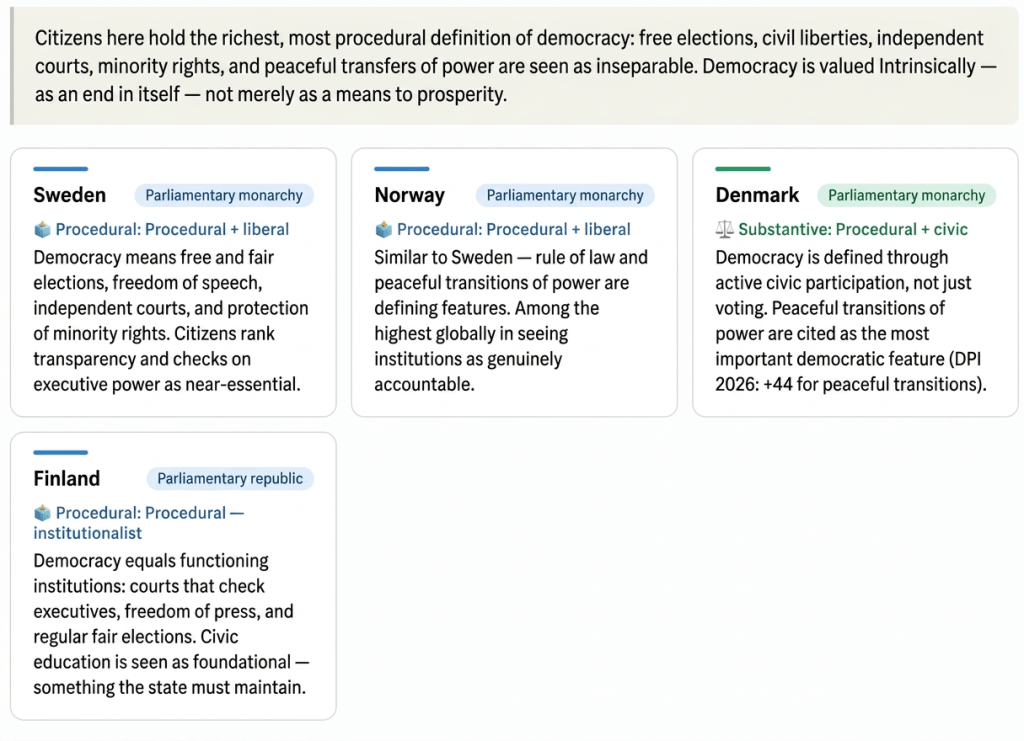
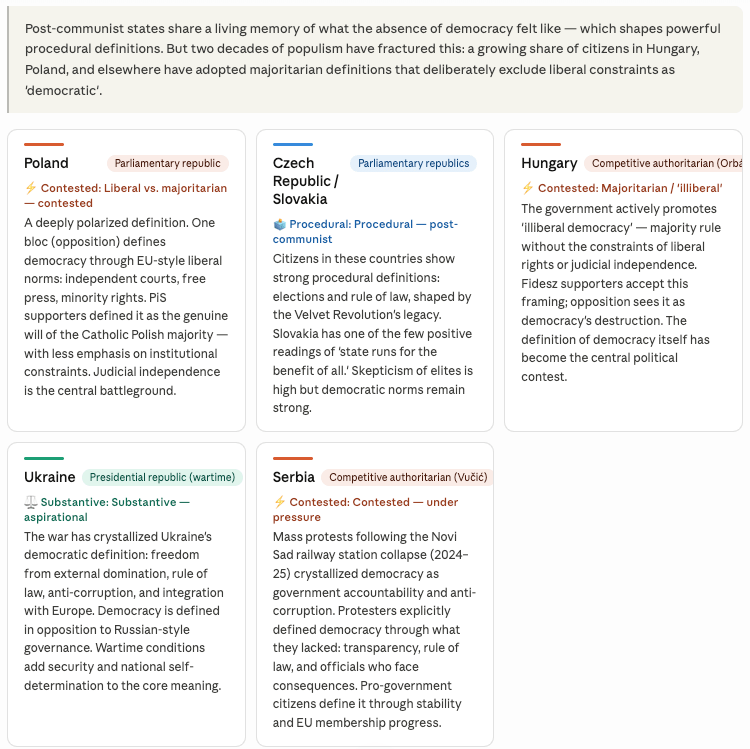
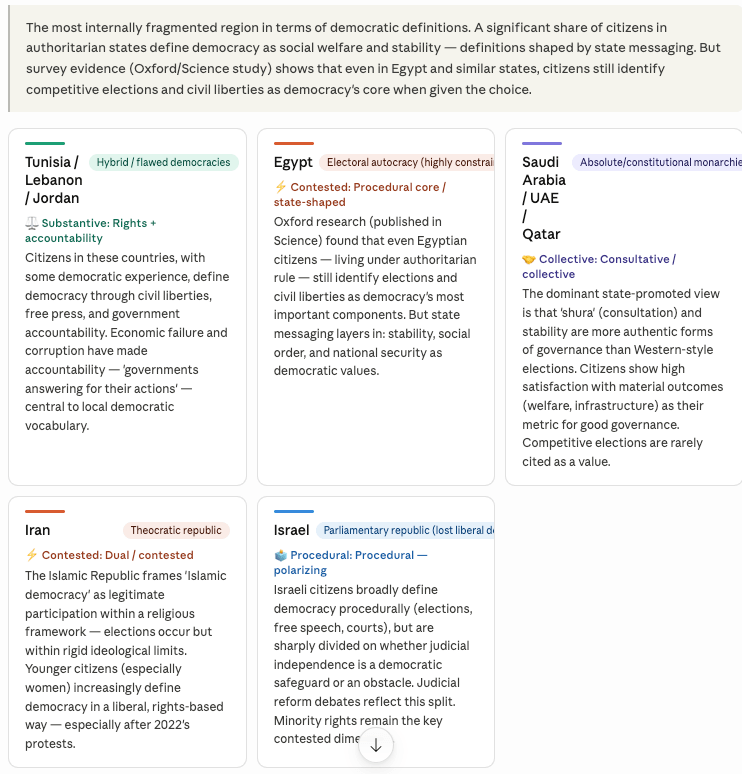
So yesterday, on a whim, I asked Claude to tell me how people thought about democracy around the world, what was their definition of democracy. I asked Claude to organize the information by region and countries. Voila! Crunching across all those same data sources, in a matter of seconds, Claude produced the following:

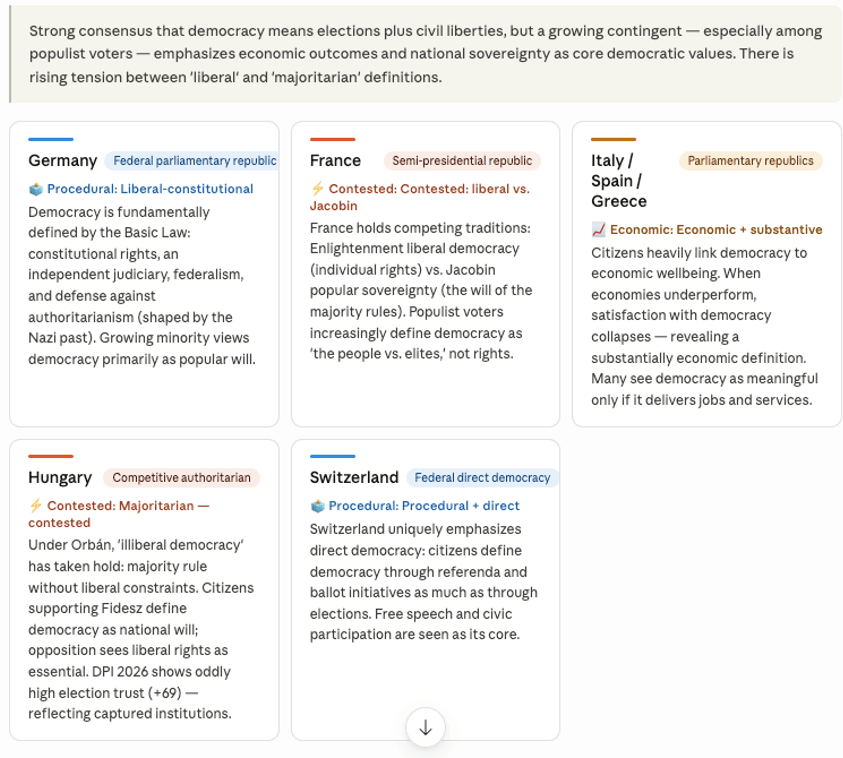
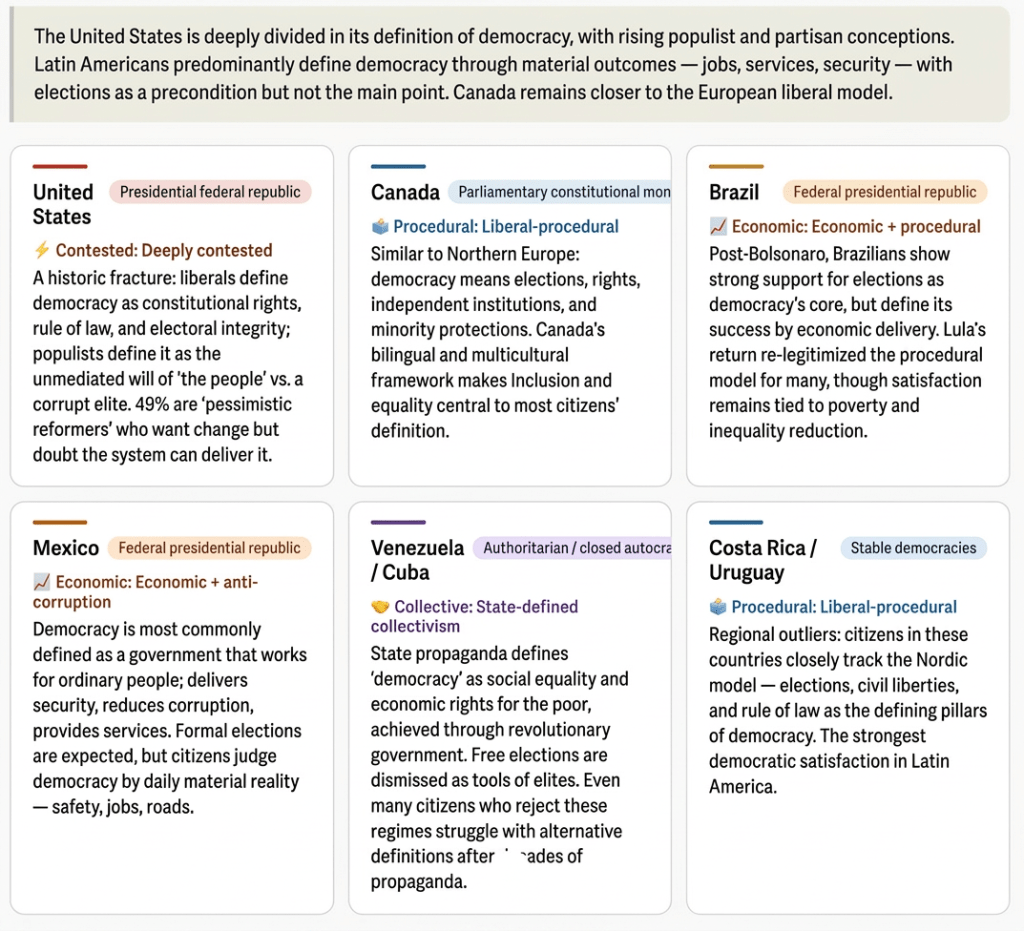
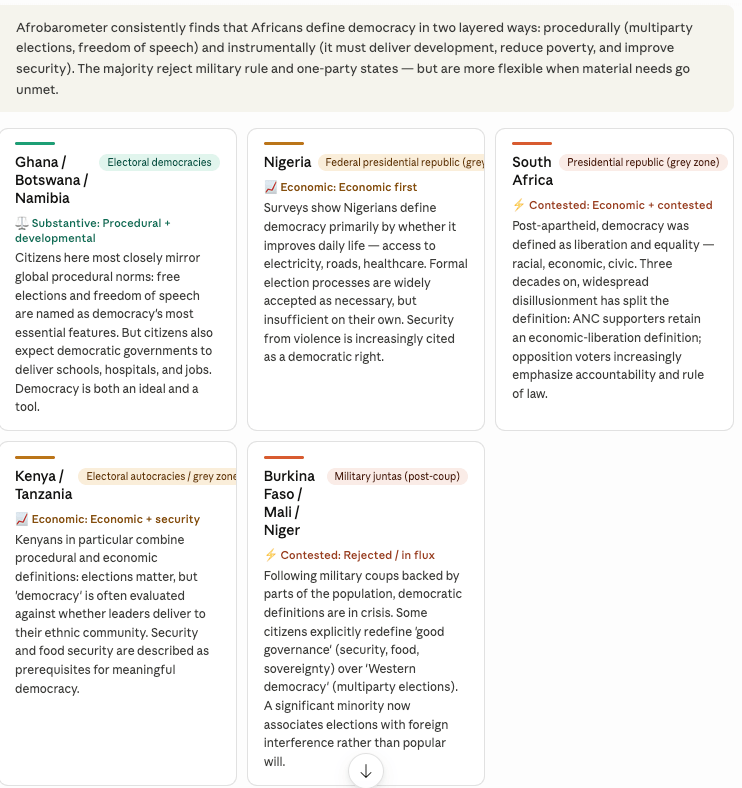
It then synthesized and organized the data by region and country, pulling out the most common concepts associated with democracy across the globe.
Nordic Europe, which consistently scores highest on democracy metrics, unsurprisingly shows up in the synthesis as having citizens who equate democracy not just with elections and rule of law, but also with civil liberties and minority rights.
But beyond the Nordic belt, schisms appear. Even in relatively liberal Western Europe democracy has begun to mean good economic outcomes with an emphasis on national sovereignty, while in the Americas, including in the United States, citizens increasingly see democracy through material lenses such as that of jobs, security, etc.
In poorer parts of the world, such as sub-Saharan Africa, where fledgling democracies struggle to survive, the electorate often views democracy as an instrument for delivering development, reducing poverty and improving livelihoods and security.
Other prompts can further fine tune these outputs. One could ask Claude to include specific, illustrative data points in the narrative or to focus on a particular set of countries, or to compare across countries and/or time. The possibilities are endless. What, just a few short months ago, would have taken hours of analytical work, shifting through reams of data, with or without a dashboard, can now be accomplished in a matter of minutes with a few well chose queries and prompts.
But it is important to remember Prospero’s rebuttal–”Tis new to thee.” And all new things must be handled with caution lest we like Caliban take a “drunkard for a god” and worship a “dull fool.” Ultimately, it is important to remember that AI can only pull from that what already exists and if there be fault in those data or if the data do not exist then no amount of AI skulduggery or hallucination will fix that problem.
So, in a world where our analytical skills too might increasingly obsolete, what do we as human beings bring to the table today that still is more valuable than any supercomputing bot out there. I am tempted to say it is our sense of purpose, the directions we choose to explore, how we choose to use and apply these synthesis, how we use these analyses to shape our world and the new questions that we choose to ask. So, in that spirit, what is the definition of democracy we want the world to move toward?
Please share your thoughts about AI, democracy and how best we can utilize these increasingly powerful tools to shape a better life here on Planet Earth.
P.S. For purposes of completeness, I am including the two other regions, Eastern Europe and Asia Pacific, that Claude synthesized the definition of democracy for.
 well world solutions