
Alas people, tomorrow is the date when the vast majority of USAID personnel, with the exception of a handful of admin and other staff, officially depart the agency, and a few short weeks later the agency will be formally laid to rest. So today, I wanted to take a moment and highlight the amazing work that my colleagues at USAID’s Bureau for Resilience, Environment and Food Security in collaboration with partners at ICF did to put together a toolkit on conducting population-based surveys in low- and middle-income countries.
The U.S. government’s flagship global initiative to end hunger, poverty and malnutrition, Feed the Future, sought to obtain population-level impacts in its geographic focus areas. To assess these impacts, USAID contracted with ICF to conduct random sample population-based surveys in these areas. These surveys were also often conducted by other organizations and partners, such as IFPRI and the World Bank.
In order to ensure consistency and comparability, USAID developed a toolkit to conduct these surveys. While, Feed the Future surveys are now a thing of the past, the information contained in this toolkit is relevant to other similar surveys. The latest toolkit, based on best practices in survey research, contains detailed instruction on:
The toolkit to conduct previous rounds of the survey contains many more protocol documents that we were in the process of updating for this round, but sadly it was work we could not finish prior to being disbanded.
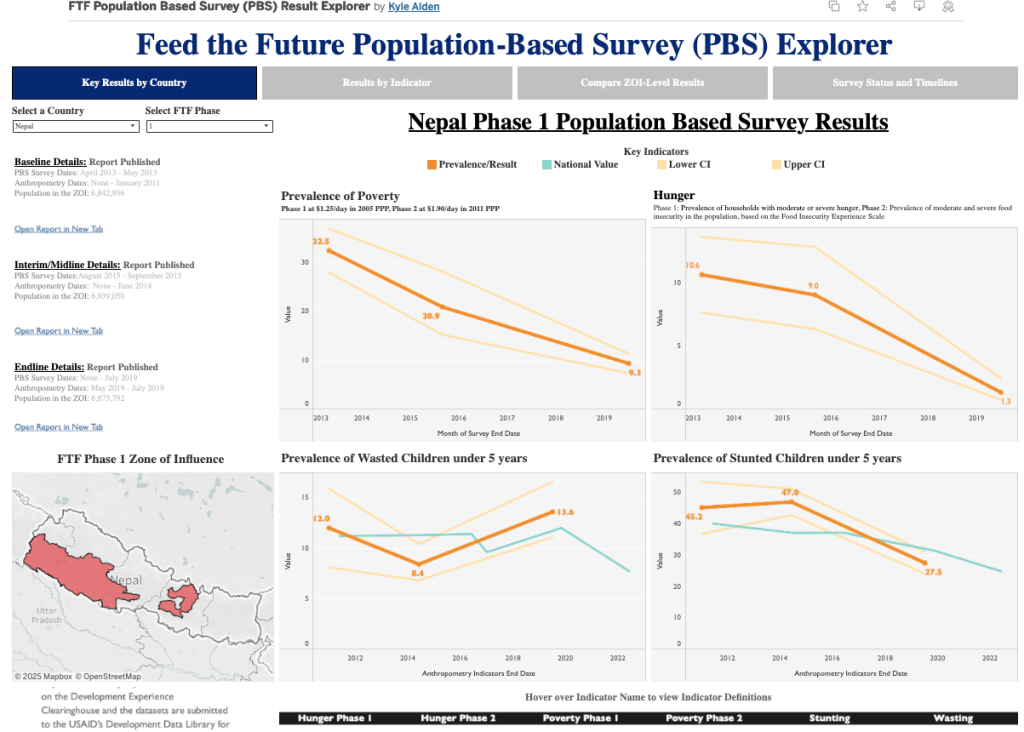
Additionally, my former colleague, Kyle Alden, revived the dashboard that we were creating to provide access to the Feed the Future survey findings. It not only shows key indicator data by various countries, but also provides access to the full survey reports and (I just noticed) has handy-dandy, easy-to-access links to the various toolkit documents. Do check it out when you get a chance.
 well world solutions
Leave a comment