
Today I wanted to talk a little bit about some of the work we were doing at the U.S. Agency for International Development (USAID). In the last few years, I had the privilege of creating new metrics to measure the impact of the U.S. government’s flagship initiative, Feed the Future (FTF), designed to reduce hunger, poverty and malnutrition around the world. In areas where FTF worked, the initiative contributed to an estimate 23.4 million more people living above extreme the poverty line, 3.4 million children not being stunted and 5.2 million families not going hungry. But globally more than 700 million people live in extreme poverty.
FTF could only do so much on its own. To have greater impact, FTF staff were well aware that we needed to more effectively work with our partners in the private, public and non-profits sectors. To better under how well FTF was working with partners and stakeholder by influencing their decisions and leveraging their resources, we, with the help of our research partners at I4DI, conducted a series of case studies. These case studies were conducted in Kenya, Nigeria and Honduras.
The case studies sought to answer 3 main questions:
1) how FTF staff and stakeholders conceptualize influence and leverage;
2) the pathways through which influence and leverage were achieved and the drivers facilitating these pathways; and
3) how influence and leverage processes and outcomes might best be measured within FTF.
The case studies found:
2 combined pathways of both influence and leverage: 1) Strategic Engagement and Collaboration; and 2) Data and Evidence Generation, Dissemination and Use
2 influence pathways: 1) Localization and Capacity Development; and 2) Innovation and Technology
2 leverage pathways: 1) Market Systems Development; and 2) Strategic Resource Alignment and Mobilization.
Learn more about these pathways of influence and leverage here. Internally, we also dug through the findings to think about the pathways in a slightly different manner (see below).

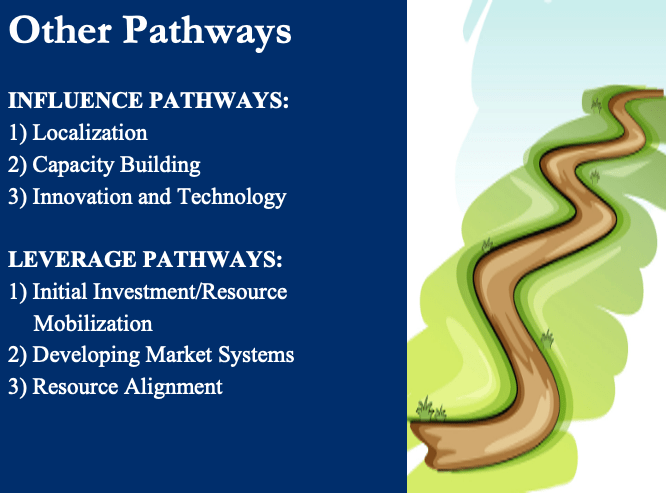
You can see more details about these slightly modified pathways here.
We had just begun the work to systematically measure FTF’s influence and leverage and were developing a set of quantitative and qualitative instruments with another research partner when sadly we got DOGE-ed. If anyone is interested in discussing our approach to measuring these concepts, please drop me at line.
 well world solutions
Leave a comment